By Duane Thomas
The term “misfire” means, when we pull the trigger on a firearm, the cartridge does not fire, we get a click instead of a bang. There are a whole host of reasons that might happen, but fortunately by far the most common is also the easiest to avoid.
(Misfires in rimfire ammunition such as .22 Long Rifle are a completely different topic than what happens in centerfire ammunition. Since rimfire ammunition is not commonly reloaded, our discussion here applies only to reloadable, centerfire ammunition.)
The primary reason a cartridge misfires is a failure, when handloading, to fully seat the primer in the primer pocket. This gives us a phenomenon called a “high primer” where the primer, instead of being fully seated, visibly sticks up above the base of the cartridge.
For priming compound to ignite, giving us the spark igniting gunpowder which burns and powers the bullet downrange, sufficient impact force must exist to mash the priming compound between the primer’s cup and its anvil (the latter being that little trefoil-shaped piece, with three holes in it, you see when looking at the non-smooth side of a primer – kind of looks like a radiation symbol). That means the primer has to be hard up against the bottom of the primer pocket, with the anvil actually touching it. If the primer is not fully seated in the primer pocket, instead of impact force being transferred sufficiently to ignite the priming compound, the firing pin strike will simply force the primer further into the primer pocket, this absorbs so much impact energy that we get a click instead of a bang.
At this point, the primer is full-seated, we might be thinking “Just pull the trigger again, it’ll go the second time.” Sometimes true, but not always. Sometimes insufficient firing pin impact causes priming compound to fragment and redistribute itself inside the primer, away from the impact site, and it won’t ignite no matter how many times you pull the trigger. This assumes to start with, of course, you’re firing something like a double action revolver/auto with second-strike capability. Really, you’re better off just racking the action to shuck out the offending cartridge and trying again with a fresh round.
Ammunition companies have measured the amount of impact force lost when a firing pin hits a high primer, and it can go up to 50 percent, especially in something like a revolver fired double action, when the hammer doesn’t come as far to the rear, thus the hammer spring is not nearly as compressed and stores less energy, as when it’s fully-cocked in single action. This phenomenon is also at play with the double action first-shot on a DA/SA autopistol. It’s also worth noting, modern striker-fired autos don’t hit primers nearly as hard as guns with external hammers.
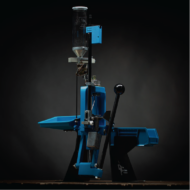
Good news: Avoiding this sort of malfunction is quite easy. To start with, make it a habit to press hard on the handle of the reloading machine when seating primers. Pay attention to the feedback the machine gives you through the handle. While most primers seat easily, occasionally a tight primer pocket requires considerably more pressure; those are the casings most likely to give you a high primer, so put a little extra force into those.
When case-gaging ammo after loading, and before it goes into your Dillon ammo boxes, take that opportunity, while the round is sitting in the gage primer-up, to run a finger over the primer. Make sure it’s fully seated, ideally with the top of the primer actually slightly below the base of the cartridge. Follow those few simple rules and, granted no issues with the gun itself, you can completely avoid those nasty moments when you get a click instead of bang.