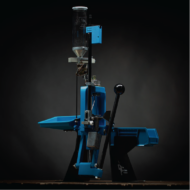
Reloading Safety
When reloading, ALWAYS wear safety glasses and hearing protection.
Never force an operating handle on a loader. If the effort needed to cycle the loader drastically changes, don’t force it.
Stop and determine the cause. Don’t smoke, watch TV or cat videos while loading. Store primers and powder out of reach of children and away from heat or open flames.
Reloading Area
If you have space for a bench, it should be typically between 36 and 42 inches tall. Ideally, you can bolt the machine permanently to the work surface. However, you can also bolt the loader to a 2×10” plank, at least 18” long, and use a couple of large cast iron C-clamps to temporarily mount the loader to a work surface, such as a bar or table.
Avoid positioning the machine directly under florescent lights, as any accidental primer detonation will result in glass particles raining down, a greater hazard than the primers.
Applications
Action Shooting Sports
Be aware that many powders are temperature sensitive. Since your ammunition has to be loaded to meet a power factor, you are advised to chronograph your ammunition at both temperature extremes you might shoot at, to see how your velocity will change.
Some powders decrease in velocity as they reduce in temperature, others increase. It is quite possible to fail to achieve power factor due to temperature changes.
Precision Rifle Shooting
Precision rifle shooting requires the use of higher-quality components, and more case preparation. Precision rifle shooting is frequently shot at ranges beyond the typical hunting or even service rifle distances – shot out to 1000-1300 yards are not uncommon.
For example, even after buying match brass and bullets, you still need to weigh and measure them, to sort out any that fall outside of a small range of tolerances.
Primers pockets are cut to ensure uniform primer seating, flash holes are deburred to aid in uniform powder ignition. And case necks are turned to give uniform neck tension on the bullet. If using extruded powder, charges are often weighed, instead of being dispensed using a measure.
A micrometer bullet seater is used so small adjustments can be made to bullet seating depth. Bushing-type neck sizing dies are used so you can experiment with different neck tensions to hold the bullet in order to determine the effect on accuracy.
Four Components of Ammunition

Metallic ammunition, as for rifles and handguns, consists of four components:
- Brass case
- Projectile
- Primer
- Powder
Brass Case
The case is a container, the primer is pressed into the base of the case, powder is poured inside of the case, the projectile, also known as a bullet, is pressed into the top of the case to seal it into one unit, called a cartridge.
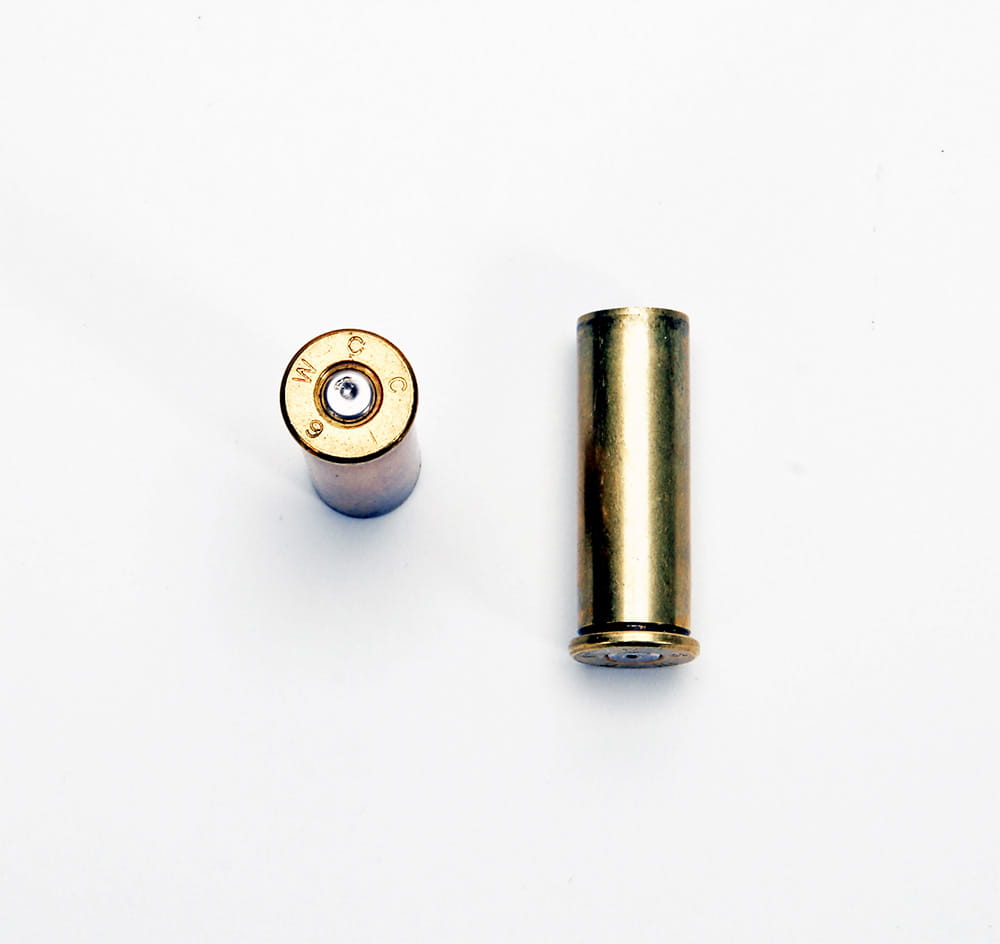
There are two styles of case bases; rimmed, which has a flange to limit how far a cartridge can go into the chamber, and rimless, which usually has a small groove turned in the base for extracting the case from the chamber.
There are three styles of upper portions of the case; straight wall, where the mouth and lower parts of the case are the same diameter, tapered where the mouth is smaller, then steps distinctly to a larger diameter at a point where the bullet stops inside the case, down to the base.
Cartridges can have a mix of bases and upper portions, examples such as .30-30 Winchester, which has a rimmed base and a bottleneck shape to the body; .38 Special, which has a rimmed base and a straightwall case body; the .30-06, which has a rimless base and a bottleneck shape to the body; .45 ACP, which has a rimless base and a straightwall case body; .30 Carbine, which has a rimless base and a tapered case body.
Projectile
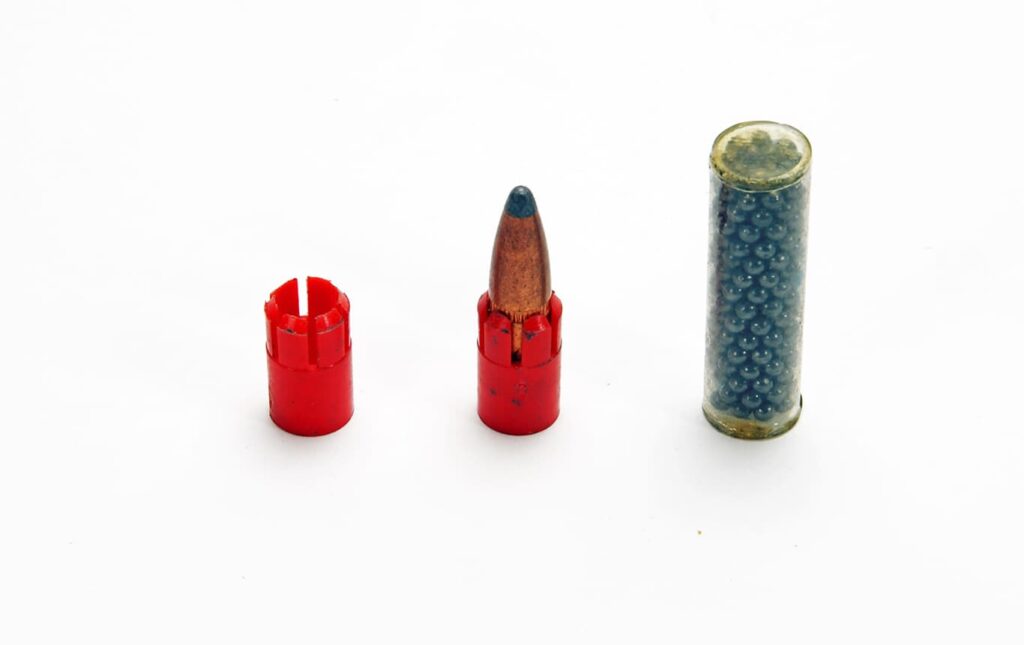
The projectile is the only portion of the cartridge to be driven down the barrel. Most projectiles are made of a lead alloy, sometimes with a copper alloy covering the lead alloy. These are called jacketed projectiles.
There are some special-purpose projectiles made of a solid copper or bronze alloy; these are encountered either in custom hunting ammunition or in law enforcement for piercing soft body armor, depending on the alloy and cartridge.
Powder
Smokeless gunpowder is not an explosive; it is described as a solid propellant. When smokeless powder is ignited it produces a large volume of expanding exhaust gasses. When contained inside of a cartridge case, these gasses are temporarily trapped by the bullet, building up thousands of pounds of pressure. This causes the bullet to be forced out of the front of the case and through the barrel of the firearm, as this is the path of least resistance.
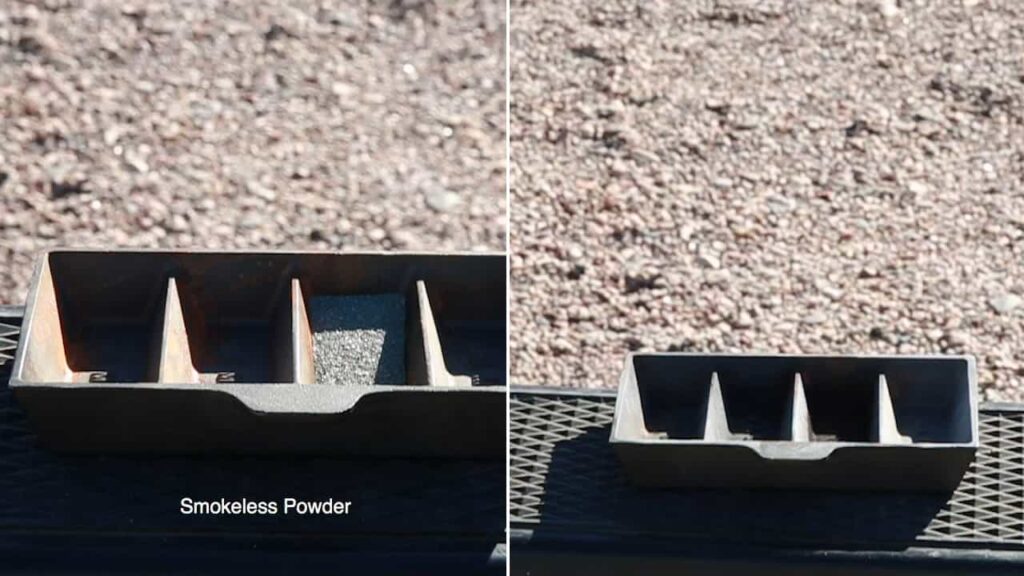
If powder is ignited outside of a case, it burns like paper, only faster. There are over 100 different varieties of gunpowder, differing by density, shape and burning rate. In general, handguns use faster-burning powders than rifle cartridges do. Most handguns have an upper limit to the projectile velocity of 1200-1400 feet per second. Most rifle projectiles travel significantly faster, between 2200-4200 feet per second. Powder and ammunition manufacturers use sophisticated equipment to determine how much of what type of powder is correct for a given cartridge and bullet type and weight. For reloaders, they make this information available in a reloading manual. It is a cookbook for reloading.
Primer
The primer is a small amount of impact-sensitive explosive, inserted into a soft brass cup, with a perforated piece of brass called an anvil positioned on top of the priming compound. When the firing pin of a firearm impacts the primer, the priming compound is rapidly compressed between the primer cup and the anvil, providing the impact to set off the priming compound.
The hot flash from the exploding primer goes through a small hole, igniting the powder charge. There are four major groups of primers for metallic cartridges, small pistol, large pistol, small rifle and large rifle. Each group is also offered in a standard and a magnum primer, with magnum primers providing a hotter ignition for use with certain powders or larger-volume cases.