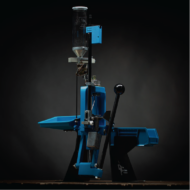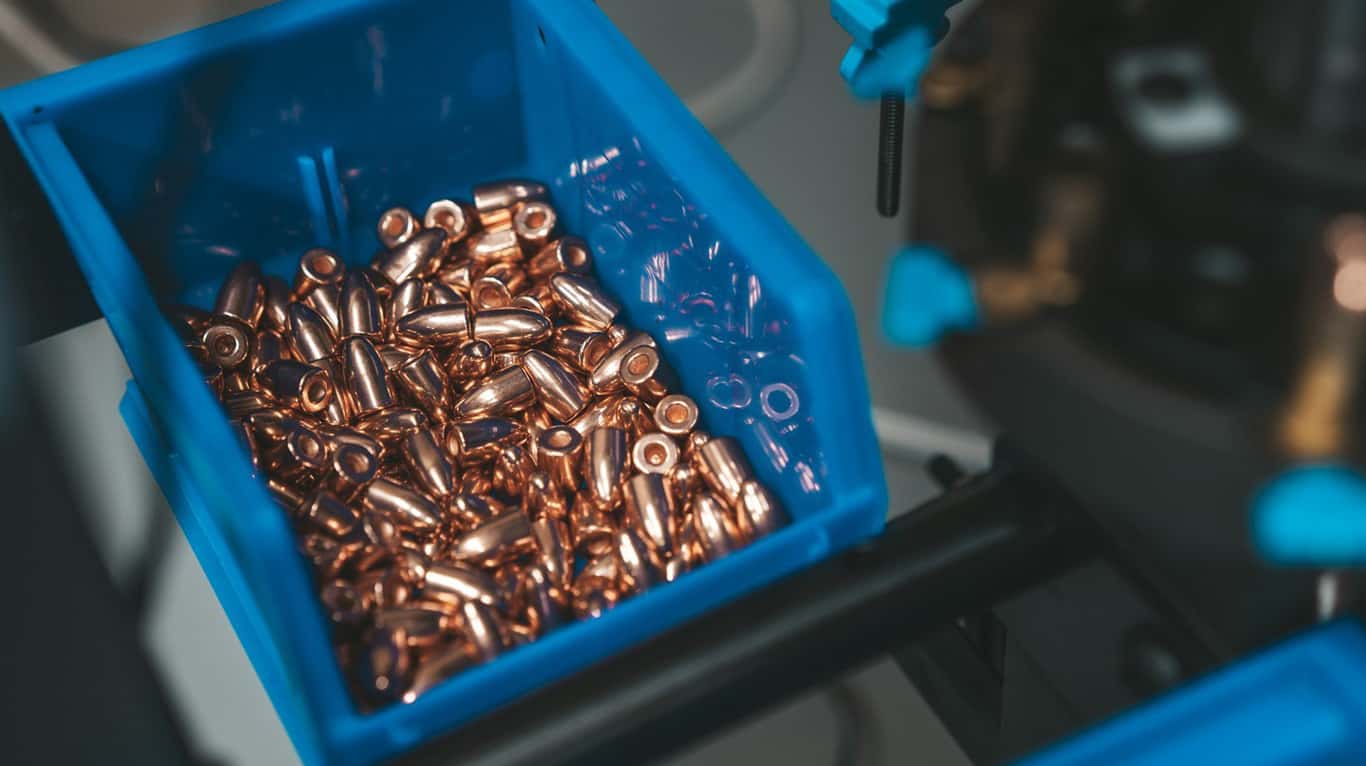
When reloading ammunition, you typically start out with empty, fired cases. These can typically be reused anywhere from five to 20 times or more, depending upon the specific cartridge. This empty case must undergo a series of steps to be converted back into a live, loaded cartridge:
- Case Preparation
- Resizing, Depriming, & Repriming
- Powder Drop & Case Flaring
- Bullet Seating & Crimping
Case Preparation
It’s a good idea to clean cases to get dirt, grit and chunks off the outside of the cases. Bright n’ Shiny doesn’t hurt, but isn’t necessary. Clean brass cases are easier to inspect. Corncob is a better all-around media. Walnut has a shorter lifespan, is too abrasive to polish, and is best restricted to stained or tarnished cases. Use corncob for general cleaning and polishing. A vibratory cleaner is fastest for tumbling brass.
If you have a vibratory case cleaner, then you can safely tumble loaded ammo in plain corncob for about 10-15 minutes to remove case and bullet lube. I suggest not using any polishing additives containing ammonia, such as Brasso, as the ammonia weakens the brass cases.
For smokeless powder, there is no reason to clean primer pockets. It’s a waste of time and adds no quality. Current priming compounds are sufficiently clean burning that it isn’t a problem of residue to prevent primers from seating fully.
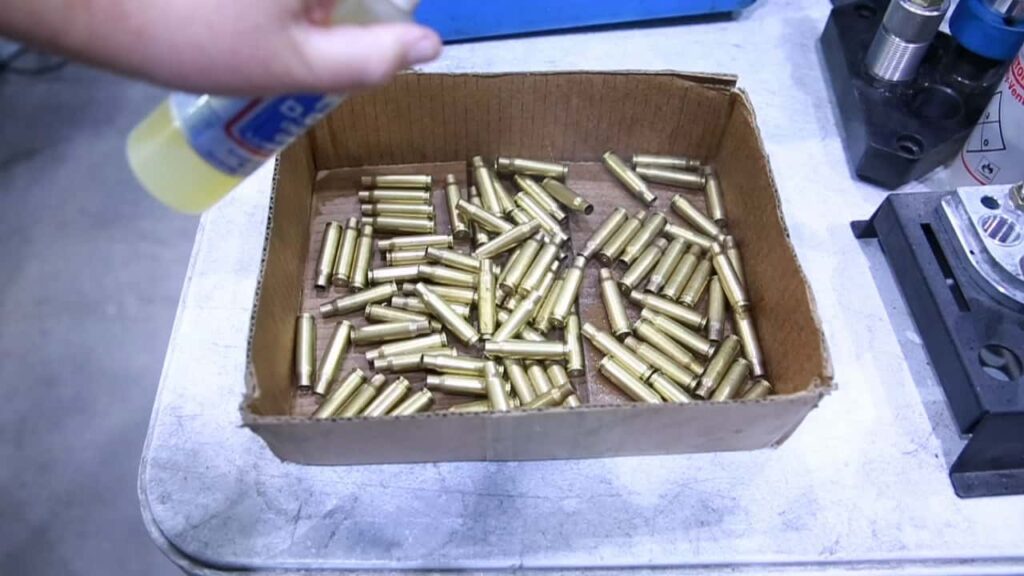
Do not deprime cases prior to cleaning with dry media. There’s not enough movement to clean the primer pockets and media gets caught in the flash hole. If not removed, media can cause misfires, failures to ignite powder, which isn’t any fun.
After the empty cases are clean, inspect the cases for defects, which render the cases unsafe to reload. Sometimes brass cases will develop cracks, there might be debris inside the case, which can include, but is not limited to, mud, spider webs, wasp nests, mystery brass, smaller-diameter cases stuck inside larger cases after tumbling. If you have picked up someone else’s empty cases, there may be empty cases that are not reloadable mixed in among the reloadable cases. Cases made of steel or aluminum are generally considered to be non-reloadable.
Straightwall cases, regardless of being fired in a revolver or a rifle, do not require trimming. Straightwall cases get shorter over time, not longer. With extensive use, cases can get uneven, but a separate crimp die will ameliorate this problem.
If loading a bottleneck rifle cartridge, cases may have to be trimmed to reduce their length. Upon firing, brass flows from the base of the case towards the mouth. You must measure the case length AFTER resizing to see if the case must be trimmed. Most bottleneck cartridges can be fired two or three times before trimming is necessary. On straightwall cases, since there is no restriction in front, they tend to get slightly shorter with reuse. This length reduction has no effect on the use of the brass. On tapered cases, such as .38-55 and .45-70, the light loads Cowboy Action Shooters typically employ do not develop enough pressure to cause the cases to stretch.
Now that we have cleaned and separated out the reloadable cases, we can begin the reloading process.
Resizing, Depriming & Repriming
The first station on our reloader is going to push out the used primer, reform the fired case so it will fit into a firearm chamber and hold a bullet tightly. Upon firing, a case expands to fill the chamber; the chamber is always slightly larger than the loaded ammunition. Therefore, the fired case gets resized and deprimed. Bottleneck and tapered cases require lube to be applied to the exterior of the cases prior to resizing. The reason for this is the cases require a sufficient amount of pressure to resize, that if the cases are not lubed, then they can stick in the size die. Often a stuck case will be stuck sufficiently that the rim will rip off before the case can be extracted. A stuck-case removal tool is usually necessary to extract the stuck case from the die without damaging the die.
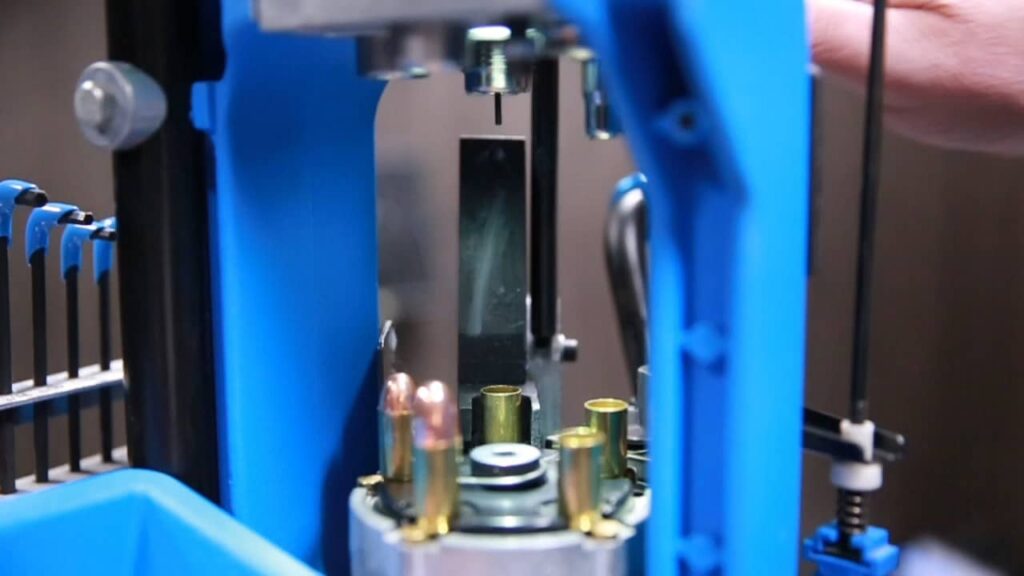
Most modern dies resize and deprime at the same time. Next, a new primer is pressed into the empty primer pocket. Most reloaders seat primers by feel. Federal primers are popular, especially for use in revolvers with action jobs, to ensure reliable primer ignition. Federal primers are the softest, followed by Winchester. All primers require care when handling. Don’t do anything that might create an improvised firing pin. If a primer fails to ignite on the first strike, but goes off on the second strike, then the primer was not properly seated initially. Primers are seated slightly below flush so that casual handling of the ammunition won’t accidentally set off the cartridge. On metallic cartridges, primers are usually seated about .002”-.007” below flush. If excess pressure is applied, you can crack the primer pellet, which will cause the primer to fail.
Be aware that large rifle and large pistol primers are not interchangeable. Large rifle primers are typically about .008” taller than large pistol primers, and won’t seat flush in cases cut for large pistol primers. Even if fired in rifles, cartridges such as .44-40 and .44 Magnum use large pistol – not large rifle – primers.
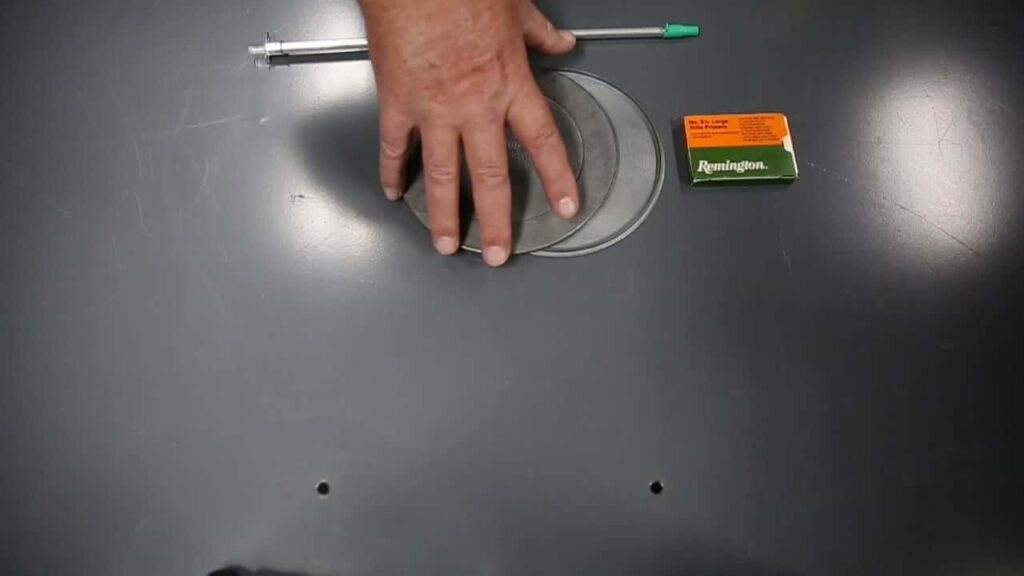
How To Use A Primer Flip Tray Properly
Dump primers out of their box onto the side of the tray with concentric rings. Gently agitate the tray in a swirling motion until all of the primers are flat. It doesn’t matter how they’re oriented. Use the primer pickup tube and press the tip over all the primers that are shiny side up. Now, put the lid on the tray, turn it over and pick up the remaining primers. There’s no reason to continuously agitate the tray until all the primers are correctly oriented. That’s why it’s called a primer FLIP tray.
Powder Drop & Flaring Cases
Straightwall and tapered cases should have the case mouths flared slightly to aid in seating bullets without shaving material from the bullet. Bottleneck cases generally do not get flared. For bottleneck cartridges, instead of flaring the case mouth, the case is chamfered using a specialized tool.
Flare cases approximately .010” larger than the sized, unflared case mouth.
Always verify the powder charge weight using a scale, no matter what method you use to drop powder.
Do not go with powder charges lighter than the starting load in a loading manual.
By the way, two loading manuals are better than one, three are better than two, etc. You can’t have TOO MANY loading manuals! Most powder manufacturers use different methods of determining minimum and maximum powder charges, so it’s a good idea to review several manuals if possible.
The differences between a balance-beam and a digital scale are: Balance-beam scale has sliding poises, most use magnetic eddy currents to dampen the oscillation of the beam. A digital scale uses multiple load cells to electronically convert their deflection into a weight. Digital scales achieve a final weight much faster, and being digital are easier for some to read. They are NOT more accurate than a balance-beam scale. The industry standard for accuracy in either type is +/- 0.1 grain. Avoid the digital scale with advertised accuracy of +/- 0.2 grains, because it is not adequate for reloading purposes.
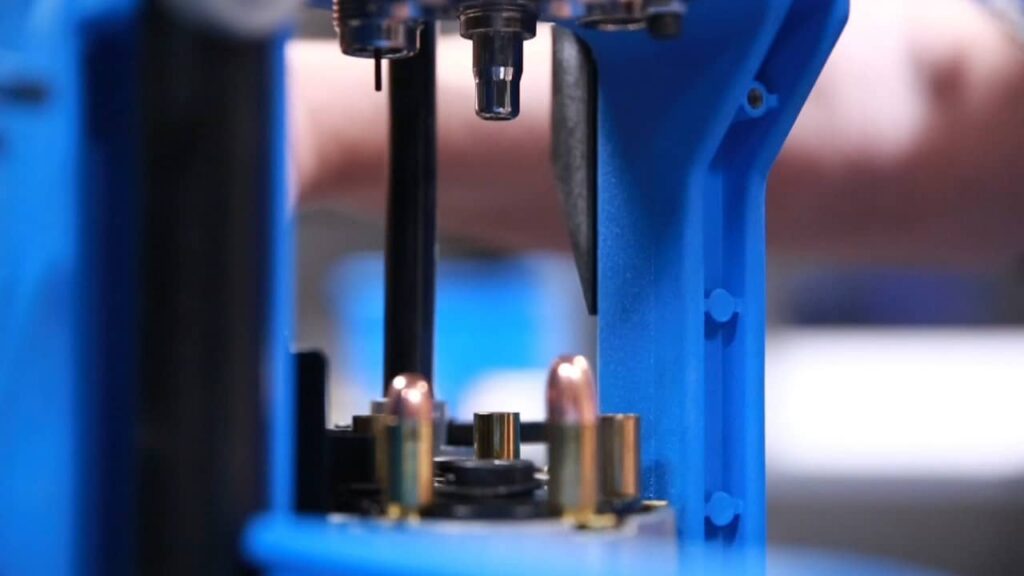
Now powder is dumped into the sized, primed case. The amount of powder that is put into a case depends upon the specific cartridge, the brand and type of powder being used and the weight of the projectile. Fortunately, the bullet and powder manufacturers make available reloading manuals for reloaders to use. This is the equivalent of a cookbook for reloaders. Powders vary by shape and density. Most reloaders use a powder measure to dispense powder. This requires the use of a powder scale to regulate the measure as to how much powder it dispenses each time. Most powder measures intended for use with metallic cartridges are adjustable by volume; this volume must be adjusted to match a specific weight of a particular powder, using a powder scale. Powder is weighed in units called grains, there being 7000 grains per pound. Powder charges are figured to the 1/10th of a grain in weight.
Bullet Seating & Crimping
Most cowboy bullets have a crimp groove to crimp into. This is a good guide. Some bullets do not have this groove, for these bullets use a taper crimp only.
Next a projectile is inserted into the case mouth. For some types of cases, notably straightwall cases, the case mouth must first be flared to speed up pressing the projectile into the case. The bullet must be pressed in to a specific depth; too deep and the pressures can exceed safe levels, not deep enough and the loaded ammunition may not fit into the chamber of the firearm. Again, the loading manual has the information as to what length is recommended.
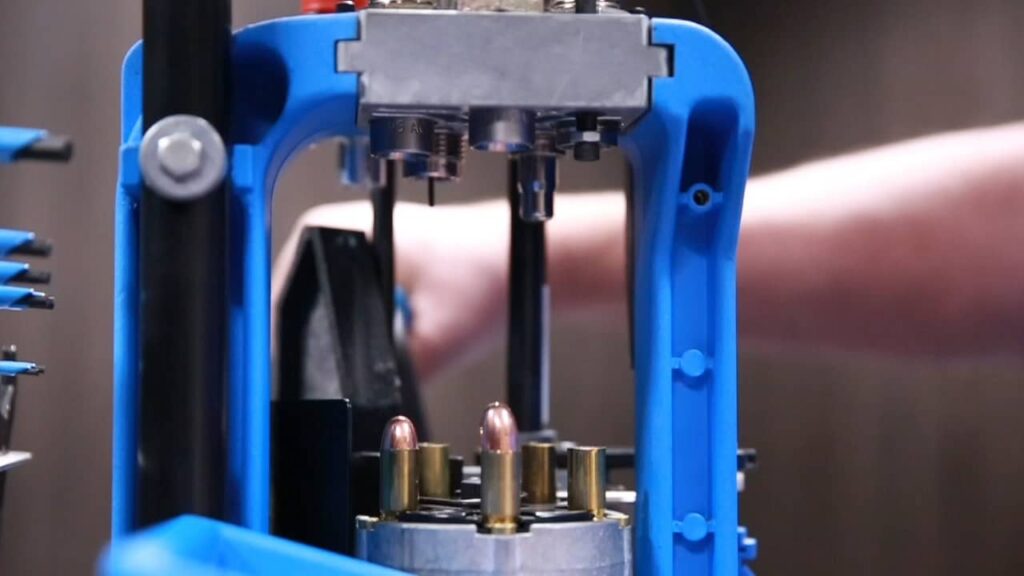
After seating the projectile into the case, a separate operation to crimp the case into a groove around the projectile may be necessary or desired. This is typically needed on cases that have the mouth flared previously.
There are two predominant styles of crimps; a roll crimp, where the case is physically curled into a crimp groove on the projectile, and a taper crimp, where the case mouth is squeezed against the sides of the projectile.
Most rifle cartridges do not have any crimp applied. Exceptions to this are rifle ammunition meant for tubular magazines (commonly lever-action rifles), ammunition for semiautomatic rifles (so that the bullet doesn’t get pushed back into the case when it is fed into the chamber of a firearm).
Most handgun ammunition is crimped; revolver ammunition is usually roll crimped to prevent the projectile from working forward under recoil; a good roll crimp prevents the bullet from getting pushed back into the case up to about 35 lbs. of pressure.
Be sure to crimp bullets in place, especially for use in tubular-magazine rifles. Use a bullet with a crimp groove. Run your thumbnail down the case mouth. If you can’t catch the edge of the case mouth, you have enough crimp. Sufficient crimp means that on tubular-magazine rifles a bullet won’t collapse into the case, which will cause most firearms to quit. On handgun ammo, a decent crimp leads to cleaner fired cases and more consistent velocities.
Semiautomatic handgun ammunition is taper crimped to squeeze the case snug against a bullet so that it doesn’t get pushed back into the case as the ammunition is fed into the chamber, while leaving the edge of the case mouth in place to prevent the ammunition from going too far into the chamber.
Post-Reloading Inspection
If brass was lubed, remove lube either by wiping or tumbling. If you have a vibratory case cleaner, then you can safely tumble loaded ammo in plain corncob for about 10-15 minutes to remove case and bullet lube.
I suggest not using any polishing additives. Inspect the heads of cases to make sure that primers are present and seated right side up. Check for wrinkles in the case neck, especially in softer cases, such as .25-20, .32-20, .38-40 and .44-40.
Hodgdon Titegroup and IMR Trail Boss are probably two of the better powders currently available for loading handgun cases, as they are formulated to be non-position-sensitive, i.e. the velocity of the bullet won’t change with the position of the powder in the case.
The cleanest powders I have experience with are Hodgdon Clays and Vihtavouri 320 (a single-base powder).
A new IMR powder, Trail Boss, is designed specifically for low-velocity lead-bullet loads suitable for Cowboy Action Shooting. It is primarily a pistol powder, but has some applications in low-velocity lead-bullet rifle loads. It is based on a whole new technology which allows very high loading density, good flow through powder measures, stability in severe temperature variations and most importantly, additional safety to the handloader. (Data available from imrpowder.com.)
If properly stored, avoiding extreme temperature variations, powder has a shelf life of over 60 years. When it goes bad, powder has a bitter, acrid odor. Powder stored in metal cans can become contaminated with rust from oxidation of the inside of the powder can. Plastic or cardboard powder-storage containers are superior.
To safely obtain lower velocities, use shorter cases to reduce case volume for safety.
.45 Colt – use .45 S&W
.44 Magnum, .44 Special – use .44 Russian
Lower bullet velocities dictate better accuracy, less leading with a softer bullet and softer lubes. Hard-cast bullets at low velocity and pressure frequently fail to “bump up” and obturate the bore, causing gas leaks around the sides, melting lead, which then condenses in the forcing cone and barrel.
Brinnell scale 8-10 is ideal for under 1000 FPS. Most hard-cast bullets are 15-16, which is meant for bullets in the 1150-1300 FPS range.
Some bullet casters are beginning to offer softer alloy bullets for Cowboy Action Shooting.